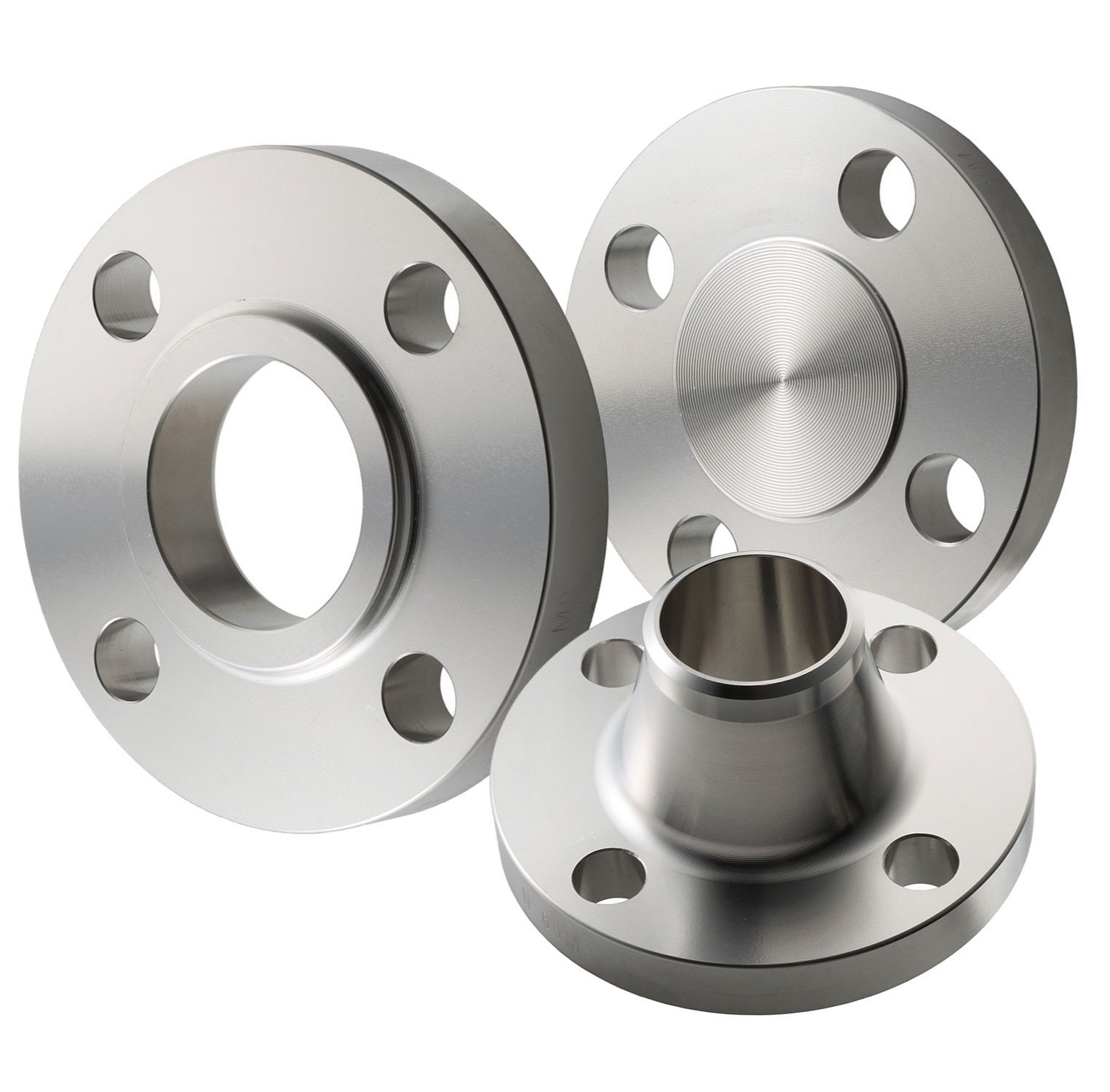
The seven flange types and where each belongs
| Type | How it attaches | Best for | Watch out for |
|---|---|---|---|
| Weld Neck | Butt weld to pipe via a long tapered hub | Critical, high-pressure, high-temperature and cyclic service | Highest cost; needs accurate bevelling and a bore matched to the pipe schedule |
| Slip-On | Slides over the pipe, fillet welded inside and out | General service, moderate pressure, cost-sensitive work | Generally limited to Class 600; lower fatigue strength than weld neck |
| Blind | Bolts on with no bore | Sealing a pipe end, vessel opening or future tie-in point | Thick sections in high classes get heavy — plan the lift |
| Socket Weld | Pipe inserted into a socket, fillet welded outside | Small-bore high-pressure lines | Internal crevice; avoid in hygienic or severely corrosive service |
| Threaded | Screwed onto a threaded pipe end | Low-pressure utility lines and areas where hot work is prohibited | Leak path at the threads; poor under vibration |
| Lap Joint | Rotates freely over a stub end | Lines needing frequent dismantling, or dissimilar-metal savings | Needs a matching stub end; lower fatigue rating |
| Reducing | Bolt pattern of the larger size, bore of the smaller | Changing size at an existing flanged connection | Not a substitute for a proper reducer where flow matters |
The lap joint deserves a mention buyers often miss. Because only the stub end touches the process fluid, the loose backing flange can be plain carbon steel while the stub end is stainless or a nickel alloy. On an exotic-alloy line, that split can take a meaningful amount out of the material cost.
What "Class 150" actually means
A pressure class is a rating designation, not a pressure in psi. The allowable working pressure for a given class depends on the material group and, critically, on temperature — every class derates as the metal gets hotter. Two flanges of the same nominal size in different classes have different thicknesses, bolt circles, bolt counts and bolt sizes, so they physically cannot be bolted together.
| Class | Approx. carbon steel rating at ambient | Typical service |
|---|---|---|
| 150 | ~285 psi (~20 bar) | Utility lines, low-pressure water, general plant service |
| 300 | ~740 psi (~51 bar) | The workhorse class for process piping |
| 600 | ~1,480 psi (~102 bar) | Higher-pressure hydrocarbon and steam service |
| 900 / 1500 | ~2,220 / ~3,705 psi | High-pressure gas, wellhead and compressor lines |
| 2500 | ~6,170 psi | Extreme pressure — typically small bore, often RTJ |
Above NPS 24 you leave ASME B16.5 entirely. Large-diameter flanges from NPS 26 to 60 are covered by ASME B16.47, which has two incompatible series — Series A (formerly MSS SP-44) and Series B (formerly API 605). They differ in bolt circle and thickness, so the series must be stated on the enquiry.
Face types and the gaskets that go with them
- ▸Raised Face (RF) — the industry default. A small raised area concentrates bolt load onto a narrower gasket area, improving sealing. Paired with spiral wound or flat ring gaskets.
- ▸Flat Face (FF) — the full face contacts the gasket. Specified when mating to cast iron, GRP or other brittle equipment flanges, where a raised face would bend the flange and crack the casting.
- ▸Ring Type Joint (RTJ) — a machined groove takes a solid metal ring gasket, usually oval or octagonal soft iron, low-carbon steel or stainless. The metal-to-metal seal is what high-pressure gas, sour service and wellhead applications require.
- ▸Tongue and groove, male and female — specialised faces used where the gasket must be positively retained or prevented from contacting the process fluid.
Material grades and how to match them
- ▸Carbon steel — ASTM A105 for ambient and moderate temperature; ASTM A350 LF2 where low-temperature impact testing is required.
- ▸Stainless steel — ASTM A182 F304/F304L/F316/F316L for corrosion resistance, F321/F347 for stabilised high-temperature service.
- ▸Alloy steel — ASTM A182 F5, F9, F11, F22 and F91 for elevated temperature and creep service.
- ▸Duplex and super duplex — ASTM A182 F51 (2205), F53 (2507) and F55 (S32760) for chloride-rich duty.
- ▸Nickel alloys — ASTM B564 in Monel, Inconel and Hastelloy for aggressive chemical and high-temperature environments.
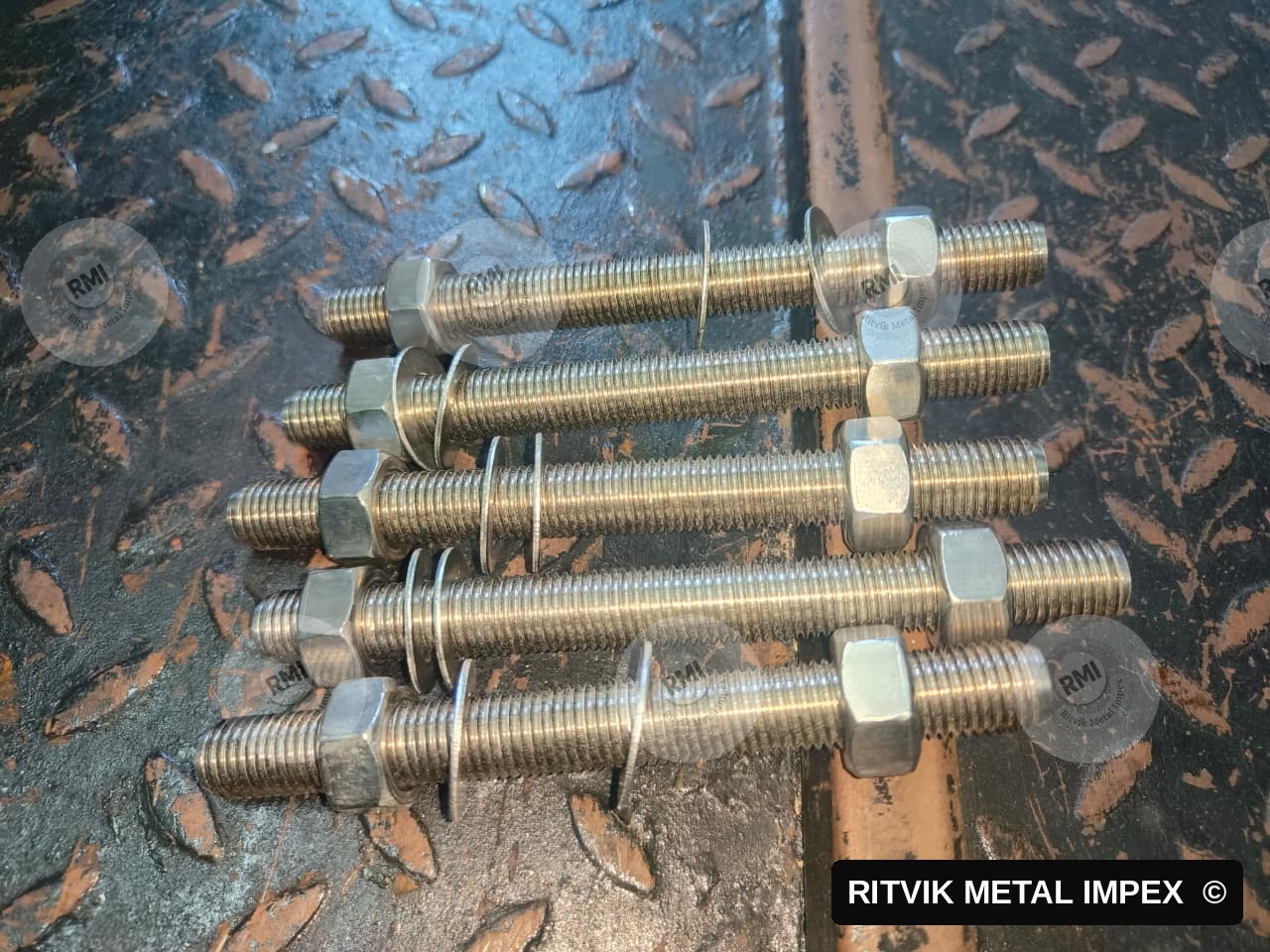
Match the flange material group to the pipe it is welded to, and match the bolting separately: ASTM A193 B7 studs with A194 2H nuts is the standard carbon and alloy steel combination, with B8/B8M for stainless service and L7/4L for low temperature. Bolting is where a well-specified flange order most often falls down.
Writing a flange enquiry that can actually be priced
A flange line item is not complete until all seven of these are stated. Sending an enquiry without them guarantees a round of clarification emails before anyone can quote:
- 1Type — weld neck, slip-on, blind, socket weld, threaded, lap joint or reducing.
- 2Nominal size (NPS) — and for weld neck, the bore, which is set by the mating pipe schedule.
- 3Pressure class — 150, 300, 600, 900, 1500 or 2500.
- 4Facing — RF, FF or RTJ, plus the finish where it matters (serrated spiral, smooth) and the ring number for RTJ.
- 5Material specification and grade — for example ASTM A182 F316L, not just "stainless".
- 6Dimensional standard — ASME B16.5, or B16.47 Series A or B above NPS 24.
- 7Certification and testing — EN 10204 3.1 or 3.2, plus any PMI, impact, IGC or hardness requirement.
Ritvik Metal Impex supplies weld neck, slip-on, blind, socket weld, lap joint, spectacle, ring joint and orifice flanges from 1/2" to 24" NB in Class 150# to 2500#, in carbon steel, stainless steel, alloy steel, duplex and nickel alloy grades, with mill test certificates and third-party inspection support.