The conductor: why purity is not an afterthought
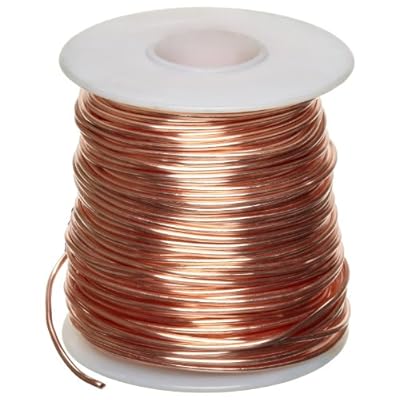
The copper itself is Electrolytic Tough Pitch (ETP) grade, drawn to a controlled diameter before enamelling. Conductivity is usually stated as a percentage of the International Annealed Copper Standard (%IACS) — commercial ETP wire runs close to 100% IACS. Lower conductivity means higher resistance for the same cross-section, which means more resistive heating in the winding at the same current. In a motor or transformer, that heat is what ages the enamel and shortens service life, so conductor quality and enamel class are solving the same problem from two directions.
This is worth stating plainly to a supplier at enquiry stage rather than assumed: ask for the conductivity grade, not just "copper wire." A wire that is dimensionally correct but drawn from lower-purity stock will still fit the bobbin and still fail early.
Insulation class is a temperature rating, not a quality ladder
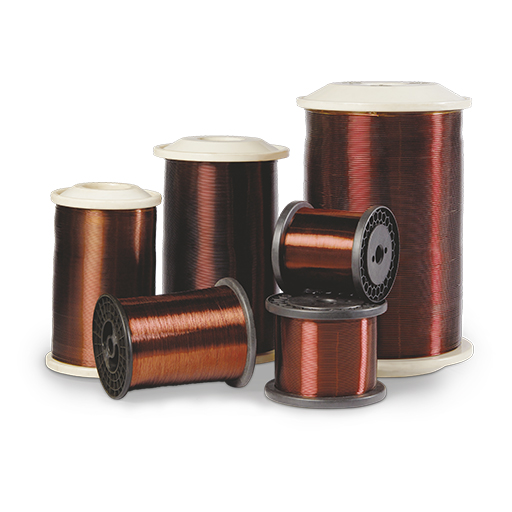
This is the single most common misunderstanding in winding wire procurement. The thermal class — 105, 130, 155, 180, 200 and above — states the maximum continuous operating temperature the enamel is designed to withstand, not a grade of quality. Specifying Class 200 for a winding that only ever reaches 110°C is not "extra safety margin" bought cheaply; it is unnecessary cost, and in some coatings a stiffer, less flexible film that is harder to wind tightly.
| Class | Typical coating | Continuous rating | Common use |
|---|---|---|---|
| 105 (A) | Polyvinyl formal (Formvar) | 105°C | General-purpose, low-cost windings |
| 130 (B) | Polyurethane | 130°C | Self-bonding, solderable coils, small motors |
| 155 (F) | Polyester | 155°C | General industrial motors and transformers |
| 180 (H) | Polyesterimide | 180°C | High-temperature motors, distribution transformers |
| 200+ (C) | Polyamide-imide | 200°C and above | Inverter-duty, servo and demanding continuous-duty motors |
SWG, AWG and millimetres are three different systems
Indian drawings commonly specify Standard Wire Gauge (SWG); US and many international drawings use American Wire Gauge (AWG); either can also be given directly in millimetres. The gauge number runs the opposite way to the diameter in both systems — a higher gauge number is a thinner wire — and SWG and AWG numbers do not correspond to the same diameter at the same gauge. A drawing marked "24 gauge" without stating which system is genuinely ambiguous, and the difference between 24 SWG and 24 AWG is significant enough to change the wire’s current-carrying capacity.
- ▸Confirm the gauge system on the drawing before ordering, not after the coil is wound.
- ▸When in doubt, specify the diameter in millimetres directly — it removes the ambiguity entirely.
- ▸Keep the gauge system consistent across a single winding specification; mixing SWG and AWG references on one drawing is a common source of rework.
Matching class to application
A practical starting point, to be confirmed against your actual duty cycle and ambient conditions rather than taken as a fixed rule:
- 1Small appliance and fan motors, low-cost general windings — Class 105 or 130 is usually sufficient and keeps cost down.
- 2General industrial motors, distribution transformers — Class 155 or 180 covers most continuous-duty applications with reasonable margin.
- 3Inverter-duty and servo motors — the winding sees repetitive fast voltage spikes from PWM switching, not just heat, and needs enamel rated for that stress specifically, typically Class 200 or a coating designated inverter-duty or corona-resistant. Ask explicitly; "high temperature class" alone does not guarantee PWM resistance.
- 4Hermetic and refrigeration compressor motors — the winding is immersed in refrigerant and oil, which needs a coating compatible with that environment, not decided on temperature class alone.